
Loops
A loop runs an agent repeatedly until a goal is actually met. It is for the long grind: an eslint burn-down, a migration sweep, a codemod across hundreds of files. That is work too big for one turn and too mechanical to babysit.
Loops versus cron
Section titled “Loops versus cron”Both repeat. They stop for different reasons, and that is the whole distinction:
| Cron | Loop | |
|---|---|---|
| Fires on | the clock | the previous iteration finishing |
| Stops when | you stop it | its goal is met |
| Knows if it worked | no | yes, a verify command says so |
| Good for | polling, reports, periodic checks | finishing a body of work |
A cron job has no goal and no oracle. A loop is nothing but a goal and an oracle.
Arming one
Section titled “Arming one”Ask, in plain words:
Set up a loop. Goal:
eslint --max-warnings=0passes. Verify withbun run lint.
The agent calls setup_loop with the goal and the verify command. It can also
seed the plan: either a list of tasks written in advance, or a hint for the
first task. With neither, the loop writes its first task itself.
How an iteration runs
Section titled “How an iteration runs”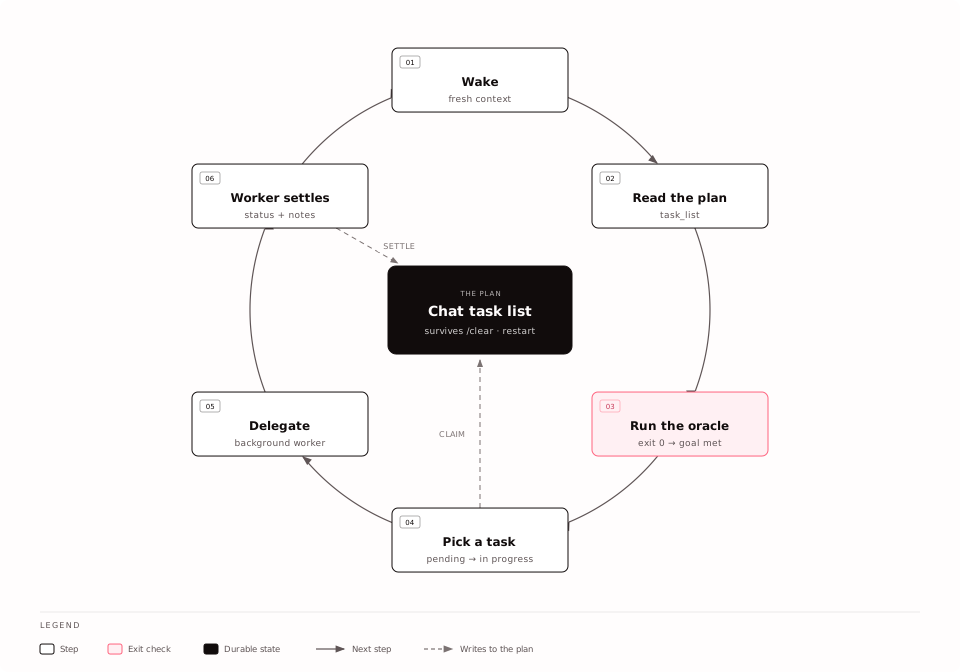
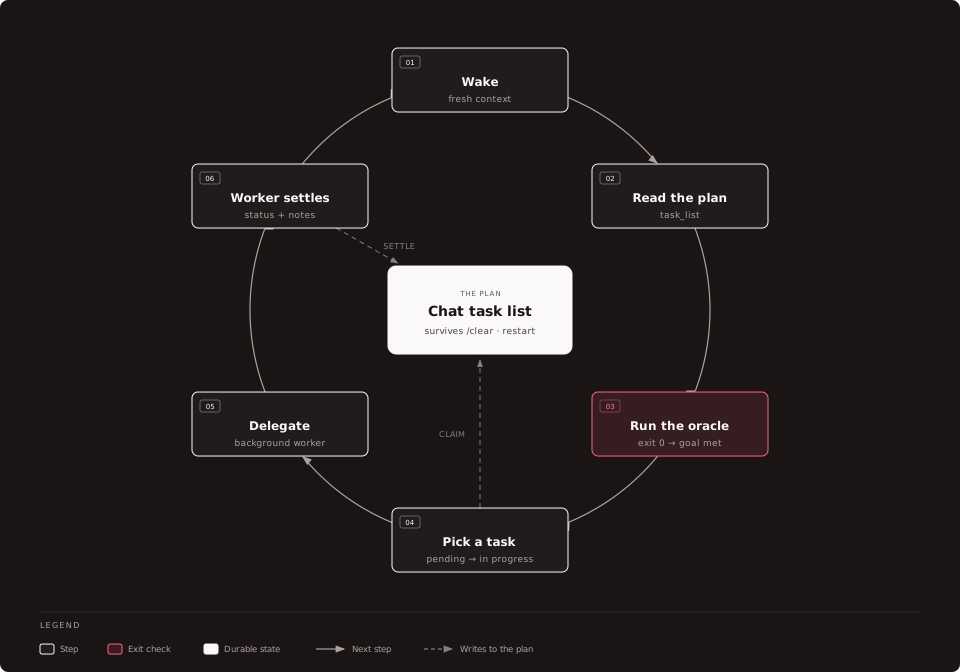
The main agent is an orchestrator. Each iteration it:
- wakes with a fresh context (Kanna clears it on purpose),
- reads the plan with
task_list, - runs the verify command,
- picks the next pending task,
- hands it to a background worker subagent and ends its turn.
The worker does the one task, records the outcome by setting the task’s status, and finishes. Its completion is what wakes the next iteration. There is no timer: a loop that is waiting on a worker costs nothing.
The task list is the only durable state
Section titled “The task list is the only durable state”The plan lives in the chat’s task list, an event-sourced record that
survives /clear, compaction and a server restart. Nothing is carried in the
orchestrator’s head between iterations, so nothing is lost when its context is
wiped.
- A task’s status is set, not appended. A finished task cannot pile up and be done twice.
- A dead end is recorded as a
failed_approachnote. Every wake carries the current tasks, their counts and the recent failure notes, so the next worker does not retry what the last one already burned an iteration on. - The same list backs the Tasks card in the chat footer, so you can read the plan at any time.
The verify command is the oracle
Section titled “The verify command is the oracle”Exit 0 means done. That is the entire contract, and it is worth choosing
carefully: the loop cannot be more rigorous than the command you gave it. The
agent runs it through run_verify, which caches the result against the state of
the working tree, so an unchanged tree is never checked twice.
setup_loop refuses to arm rather than starting something that cannot work:
- The verify command already exits 0. Either the goal is met or the oracle is too weak; starting would declare victory having done nothing.
- The chat still has unfinished tasks from an earlier plan. Arming over them would mix two plans; the error lists them.
- The worker subagent is manual-trigger, so a loop cannot delegate to it.
workdiris not the project checkout or a worktree of the same repository.parallelismis outside 1 to 3.
The first two can be overridden with force, if you know why.
It will not declare victory early
Section titled “It will not declare victory early”A green oracle is not the same as finished work. A loop once declared success at stage 4 of a 12-stage plan because its verify command flipped green early. So the decision reads two signals, not one:
| Verify | Task list | What happens |
|---|---|---|
| passes | nothing pending | Final check, then goal met; the loop stops |
| passes | still has work | Oracle too weak; stops and hands back to you |
| fails | a task is pending | Delegate it (the normal case) |
| fails | nothing pending | Write the next task, then delegate |
The second row is the interesting one: it stops rather than continuing. The loop cannot tell a stale plan from a weak oracle, and only a person can tighten the definition of done.
Before declaring the goal met, the orchestrator lists every task with no status filter and confirms each one is completed. A worker about to complete the last task runs the same check.
Parallel loops
Section titled “Parallel loops”With parallelism above 1, up to three workers run at once. Each task can
declare which tasks it needs first and which git worktree it works in,
so workers never edit the same checkout:
- A task is claimable only when everything it needs is completed and its worktree is not held by a live worker. That one rule is the whole scheduler.
- A claim belongs to a worker run, not a timer. If a worker dies, its task goes back to the queue the next time the orchestrator claims.
- Finished branches are merged into the loop’s working tree by
task_integratebefore the next claim, so a worker sees the work its task depends on.
Watching it
Section titled “Watching it”The chat footer’s Progress card lists the whole plan, one row per task, marked done, running, pending, blocked or failed, with a “Loop running” pill while it is armed. If the loop hits a rate limit the card shows when it resumes, plus a Resume now button.
The card outlives a disarm, so a stopped loop still shows what it got through.
Stopping and resuming
Section titled “Stopping and resuming”- Just type. Sending a message disarms the loop; you are taking over.
- Ask it to stop. The agent calls
stop_loop. - Ask it to resume.
resume_loopre-arms the loop it last ran, from the same spec, with no arguments needed.
While a loop is armed the orchestrator’s own editing tools are blocked. It plans and delegates; the edits happen in the worker that owns each task.
Costs and caveats
Section titled “Costs and caveats”- A loop’s per-iteration cost is a subagent run, not a chat turn. A loop that looks idle in turn-level token metrics shows up in the subagent ones.
- Loops are unattended by design. Give one a checkout it may break, such as a board card’s worktree, rather than your only copy.
- The goal is only as good as the verify command.
bun run lintis an oracle; “the code is better” is not.